


Severely Sentenced for Protecting Fellow Protesters & Never Giving Up After Jail— A Middle-Aged Protester, “Uncle Kan,” Reflects on His Life After Release
Updated: Apr 16
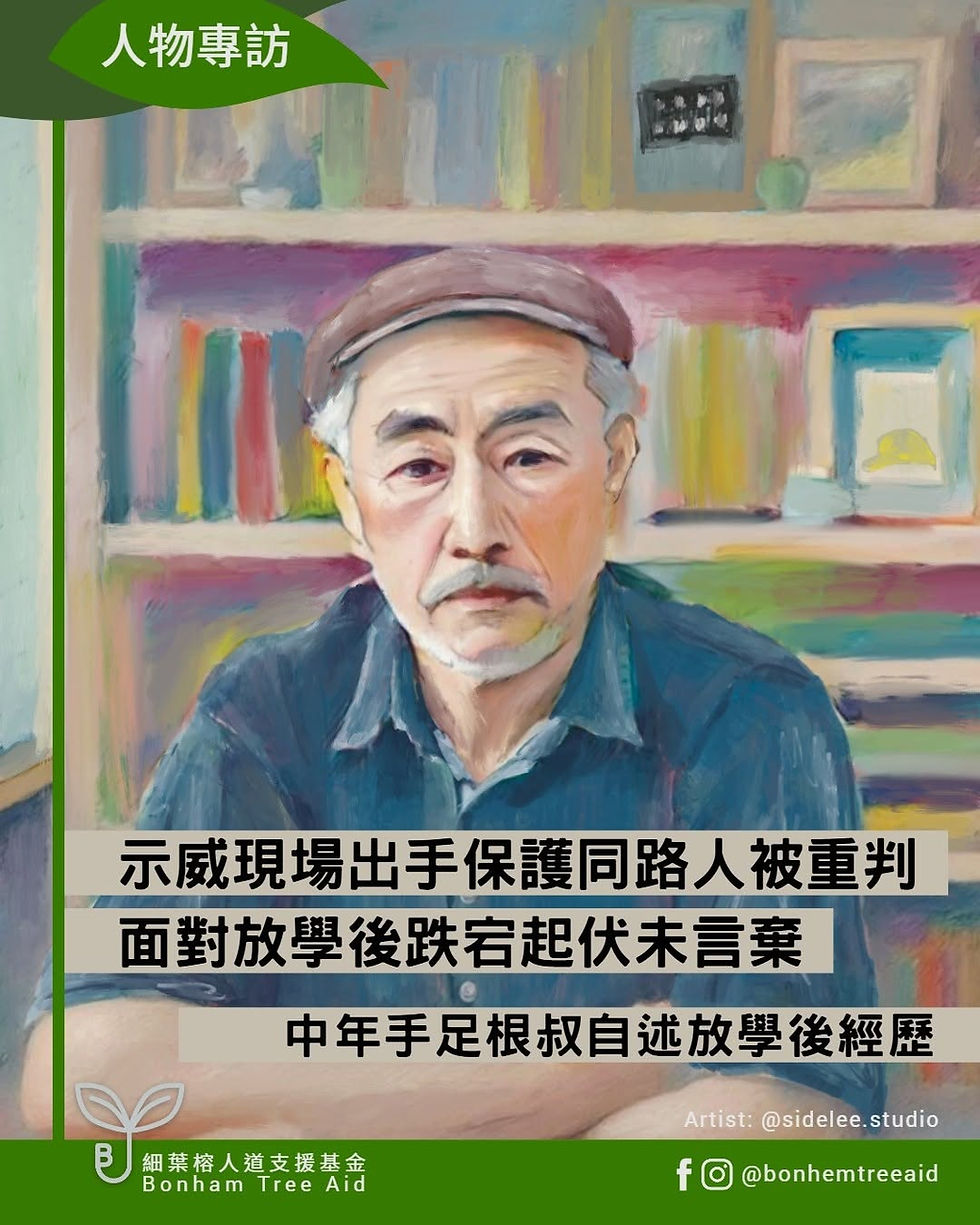
The immense momentum of the 2019 protest movement was not only about breaking away from the previous “peaceful, rational, non-violent” approach. Among those wearing black bloc and taking part in direct action were people of all ages. In this issue of Bonham Tree, “Uncle Kan” (a pseudonym to protect his identity) speaks in the first person about his journey—from participating in the movement, to imprisonment, to re-entering society—and why he initially applied for humanitarian aid from the Bonham Tree Aid.
“My name is Uncle Kan. Like many Hong Kongers, I took to the streets in 2019 to support the anti-extradition movement. But as I had to work during daytime, I only joined gatherings at night after work.”
“Until October, the night the government announced the anti-mask law—I was at the scene and saw some people holding bricks while dismantling barricades. I noticed some fellow protesters nearby and worried they might be in danger, so I stepped in to stop those dismantling barricades. Unfortunately, I was arrested.”
“Like many protest-related cases, the Department of Justice charged me under the more serious offence of ‘Assault’ (Section 17). That day, I was caught on camera in plain clothes—there was no way out, so I had to plead guilty.”
I did try to explain in court: I acted to protect younger protesters, worried that those unknown individuals holding bricks might hurt someone. But in the end, the judge didn’t accept it as a mitigating factor. I was sentenced to several years of imprisonment, and only regained my freedom at the end of 2022.”
“I started working very young to support my family, didn’t have much education, and at my age, finding stable work after release wasn’t easy. During the pandemic, the economy wasn’t great. Having just gotten out and being on my own, the beginning of rebuilding my life was quite tough.”
“Luckily, once I got out, many fellow protesters helped me—assisting with funding applications, helping me find a place to live, and most importantly, helping me get a cleaning job. That allowed me to catch my breath and slowly regain a foothold in society.”
Those who have lost their freedom understand that unresolved matters outside become even more troubling behind bars. Uncle Kan had to deal with compensation payments from his case, an unfinished lease, credit card debt, phone bills, and more. Looking back, he admits he was often anxious.
Even though he has children, they have their own lives. They have their own families to take care of. How could he, as a father, keep asking them to give more? In the end, he had to rely on friends, adding to the debts he owed them.
“I originally planned to work hard after release—take on a full-time job and then a night shift part-time job to repay the money my friends had helped cover.”
“But I didn’t expect Hong Kong’s economy to be this bad. Not long after I started as a cleaner, the company said it was shutting down. I thought earning around ten thousand dollars a month would cover basic expenses, and I could save my part-time income to repay debts. But suddenly, even covering my own living costs became uncertain.”
Of course, he felt lost and worried—it would be self-deception to say otherwise. Fortunately, while still in prison, Uncle Kan learned about the Bonham Tree Aid. After his release, fellow protesters helped him apply, and after some waiting, he was approved.
Compared to other reintegration support that only covers short-term transportation costs, the fund’s monthly subsidy of a few thousand dollars came like timely rain, immediately easing much of his financial pressure.
Many older protesters have found that looking for work after release is no easier than for younger ones. Having a criminal record rules out jobs like security guards. As Uncle Kan puts it: given his age, low education level, and slower physical ability, “If I were the boss, I wouldn’t hire myself either.”
Fortunately, with the continued support of fellow protesters, he was later introduced to another job. His new position at a laundry shop involves a lot of physical labor—lifting, carrying, going up and down—which is exhausting for someone of his age. He can no longer take on night shifts.
Still, in times like these, having stable work and an income to support himself—without having to rely on favors—is enough to make him feel content.
“These past few years haven’t been easy for many people. I’m grateful for the help from both old and new friends. After release, being able to reunite with like-minded people—no matter how hard things get, we can encourage each other. Honestly, I feel very thankful.”
“I hope everyone remembers those still behind bars, or those forced to go overseas, so they won’t feel alone. Let’s keep going.”
Illustration: @sidelee.studio
Written by: Vicent Vega
Translation: Leo


![【From Streets to Bar Counter: A Solitary Upgrade — “Do Not Go Gently into That Good Night”]](https://static.wixstatic.com/media/3aa9c0_a5ce18a90bdc47f6ae0b13edcf2512b3~mv2.jpg/v1/fill/w_1000,h_1000,fp_0.50_0.50,q_30,blur_30,enc_avif,quality_auto/3aa9c0_a5ce18a90bdc47f6ae0b13edcf2512b3~mv2.jpg)
![【From Streets to Bar Counter: A Solitary Upgrade — “Do Not Go Gently into That Good Night”]](https://static.wixstatic.com/media/3aa9c0_a5ce18a90bdc47f6ae0b13edcf2512b3~mv2.jpg/v1/fill/w_224,h_224,fp_0.50_0.50,q_90,enc_avif,quality_auto/3aa9c0_a5ce18a90bdc47f6ae0b13edcf2512b3~mv2.jpg)


