


Through the Narrow Gate to the Unknown: Teddy’s Adapting and Rebuilding
Updated: May 1
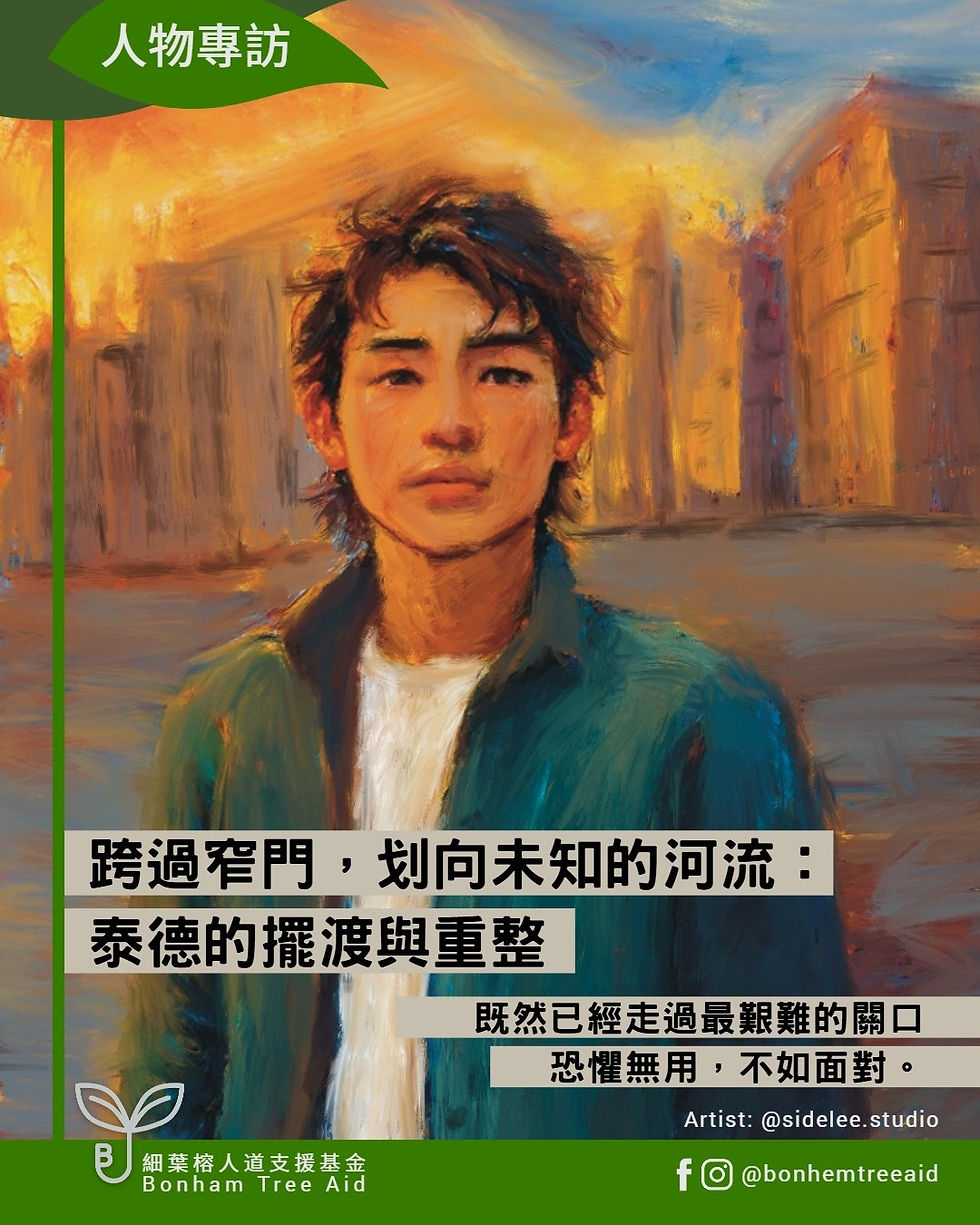
“The most difficult state has passed. Rather than being consumed by fear, why don’t just step forward?” Teddy says.
“Coming out of the rehabilitation centre was like entering a new gate. It is a not second life, because I have not forgotten the past. Instead, I’ve overcome it, and the pieces of the past make me who I am now.” Teddy sounds composed as he explains his thinking, as if he has practised the line many times to present his story to the world.
But he was not like that when he was younger. He describes himself as a timid person who would not dare to take risks. During secondary school, he disliked the rigid and boring teaching but had no choice but to accept it. In society, although issues and movements unfolded, he remained more of a spectator than a participant. He kept his distance during the anti-national education movement and the Umbrella Movement. It was not until he took part in the 2019 protests and was charged with possession of an offensive weapon that his life changed completely.
Sentenced to a rehabilitation centre due to his young age, he spent just over half a year in a life filled with meaningless discipline. Every day he marched, attended craft classes, and had short breaks. It felt like wasted time, he reflects.
With the influx of young people who had taken part in the protests, pressure on the Correctional Services surged. Given the complex environment, he had to be careful with his actions and words to avoid trouble from both staff and triad members. Teddy describes it as a low-key war zone. Whenever triad members demanded resources from him, he had to comply. When completing duty logs, he had to be extremely careful not to make mistakes. He also remembers several occasions when staff summoned him only to tear up his letters from outside, claiming it was “to ensure the centre’s normal operation”. It was an extra layer of punishment, considering offenders were allowed only two visits a month. During his time there, a district councillor came to visit him. Coincidently, the councillor was arrested two days later.
In this “battlefield”, Teddy always had to act cautiously. Looking back, he realises that caution driven by fear could not protect him — it only left him in limbo. “The most difficult stage has passed. Rather than being consumed by fear, why not just step forward?” he says. “After wasting so many years, it’s time to improve myself.”
After regaining his freedom, life moved quickly. He wrote a long list of goals. First, Teddy returned to university to pursue the subject he is passionate about. Now he is on his internship, waiting to graduate. In his spare time, he works part-time to save money. Meanwhile, he has passed his driving test and obtained his licence. To make up for lost time, there are no breaks in his schedule.
Despite his busy life, Teddy’s journey has not been smooth. There has been drama along the way. In two part-time jobs, he was almost dismissed after colleagues learned about his background through friends. Teddy considers himself lucky that employers had not conducted proper background checks. However, more obstacles may lie ahead. Many graduates from his degree go on to work in large corporations that conduct serious background checks. When he applies for jobs after graduation, he expects his conviction to become a problem.
“It is already part of my identity,” Teddy says. He cannot deny his past. He must learn new skills and be mentally prepared to explore different options, “so that I won’t be completely lost when one path is closed to me.”
With his complex experiences and deep reflection, Teddy has become a “ferryman” helping others cross the river. He enjoys sharing his thoughts while allowing people to form their own conclusions. Perhaps by helping others cross the river, he is also helping himself find the right dock.
With his passion for helping others and participating in the community, he has joined a community centre and become involved in several projects, ranging from animal rights to supporting older people. He plans to join a community group delivering food and cleaning homes for elderly residents, doing his best to help as many people as possible. While civil society has been squeezed in recent years, he believes “there are still a lot of things to do”.
His passion also extends to sport. Teddy has obtained a bouldering instructor certificate. Bouldering is about trying, exploring, failing, and trying again. As much as it is a physical challenge, it is also mental. For Teddy, every fall is essential to future success. He sees his involvement in social service in the same way — helping people get back up and try again.
Teddy realises that behind the act of helping someone lies the power of knowledge. Knowledge leads us to a better future. Recently, he has been reading a book about public housing estates, exploring their history, characteristics, and communities. Having grown up in public housing, he feels strongly about the stigma attached to this identity and wants to help build supportive communities that are often ignored.
Because knowledge and action are inseparable, Teddy plans to study for a master’s degree and then a PhD to improve his analytical and communication skills. He believes this will give him the power to expose injustice and push for change. Meanwhile, he hopes to continue volunteering. In the future, he wants to take volunteer trips to Africa and post-war Ukraine, where he can witness and document reality on the ground.
Although his plans seem well organised, Teddy knows nothing is certain. The impact of his conviction, combined with a changing global situation, makes the future hard to predict. He can only hope he will not regret his choices.
Considering both his past experiences and future plans, Teddy feels both pessimistic and optimistic. In some ways, he is like a Jedi Knight in Star Wars, trying to find his place amid chaos. “The changing global situation makes people feel we should do something,” he says. “History tells us terrible things can be done by human beings. If they can be stopped, why wouldn’t we try?”
After speaking about something so big, he pauses and chuckles. “I want to say I’m only a normal person,” he continues, as if reminding himself. “But I know I’m not.” Despite the uncertainty ahead, Teddy is determined to be a ferryman, guiding others, and himself, to the other shore despite the tides and fog.
Illustration: @sidelee.studio
Test: G
Edit: @mingyeung_
Translation: Kai


![【From Streets to Bar Counter: A Solitary Upgrade — “Do Not Go Gently into That Good Night”]](https://static.wixstatic.com/media/3aa9c0_a5ce18a90bdc47f6ae0b13edcf2512b3~mv2.jpg/v1/fill/w_1000,h_1000,fp_0.50_0.50,q_30,blur_30,enc_avif,quality_auto/3aa9c0_a5ce18a90bdc47f6ae0b13edcf2512b3~mv2.jpg)
![【From Streets to Bar Counter: A Solitary Upgrade — “Do Not Go Gently into That Good Night”]](https://static.wixstatic.com/media/3aa9c0_a5ce18a90bdc47f6ae0b13edcf2512b3~mv2.jpg/v1/fill/w_224,h_224,fp_0.50_0.50,q_90,enc_avif,quality_auto/3aa9c0_a5ce18a90bdc47f6ae0b13edcf2512b3~mv2.jpg)


